


Natural eyebrow restoration
Eyebrow Transplant in Turkey
A Turkey eyebrow transplant is a facial hair restoration procedure designed to improve sparse, uneven or partially missing eyebrows using the patient’s own hair follicles.
At byhairclinic Istanbul, each treatment is planned according to facial proportions, existing eyebrow hair, donor characteristics and the natural direction of brow growth.
Because eyebrow hairs change direction across the inner brow, arch and tail, careful graft selection and placement are especially important when planning a natural-looking result.
- Personalized brow design
- Single-hair graft placement
- Individual follow-up
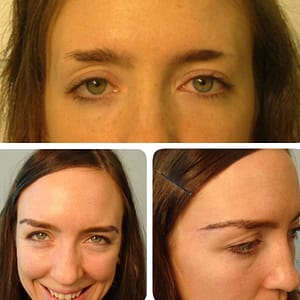
Refined facial harmony
Why Consider an Eyebrow Transplant?
Natural-Looking Density
Individual follicular units can be used to add density to sparse areas while following the existing shape and natural growth pattern of the eyebrow.
Personalized Eyebrow Design
The width, arch, tail and overall outline are planned according to facial proportions, existing eyebrow hair and the patient’s preferences before implantation begins.
Controlled Hair Direction
Eyebrow hairs normally grow at relatively shallow angles.
Careful placement helps the transplanted hairs follow the changing direction of the natural brow from the inner section toward the tail.
Individual Treatment Planning
The number of grafts and the donor area are selected according to existing eyebrow density, the size of the treatment area and the characteristics of the available donor hair.
A delicate restoration procedure
What Is an Eyebrow Transplant?
An eyebrow transplant involves extracting suitable follicular units from a donor area, usually from the scalp, and implanting them into areas of the eyebrow where additional hair is required.
Unlike microblading or cosmetic tattooing, which create the appearance of eyebrow hairs using pigment, transplantation uses living hair follicles.
After successful growth, transplanted hairs can continue to grow and generally require periodic trimming because scalp hair may grow longer than native eyebrow hair.
A Turkey eyebrow transplant may be considered for people with naturally sparse eyebrows, asymmetry, previous overplucking or selected areas affected by scars or trauma.
The underlying cause of eyebrow hair loss should be assessed before treatment planning.
Suitability depends on the donor area, existing eyebrow hair, skin characteristics, medical history and the desired brow design.
Technique and design
FUE Eyebrow Transplantation and Brow Design
Follicular Unit Extraction
An FUE-based approach can be used to extract individual follicular units from the donor area.
For eyebrow restoration, single-hair grafts are often particularly useful because they allow finer control of direction, spacing and visual density.
You can learn more about the extraction process on our
Sapphire FUE hair transplant
page.
Shape, Angle and Density
Before implantation, the eyebrow outline is planned according to facial structure and existing hair.
Grafts are then positioned with attention to the different growth directions of the inner brow, central section, arch and tail.
The objective is not simply to implant the highest possible number of grafts, but to create appropriate spacing and direction for the individual eyebrow design.
Who May Be Suitable for an Eyebrow Transplant?
An eyebrow transplant in Turkey may be considered for women and men who want to improve sparse, asymmetrical or partially missing eyebrows.
A consultation is required to identify the cause of eyebrow loss and determine whether transplantation is appropriate.
- Eyebrows affected by previous overplucking
- Naturally sparse or asymmetrical eyebrow growth
- Selected scars or trauma affecting the eyebrow area
- Patients seeking additional density or a redesigned brow shape
- Patients with an appropriate donor area
Step by step
Turkey Eyebrow Transplant: Treatment Steps
Consultation and Design
The eyebrow area, donor hair, facial proportions and treatment goals are assessed.
A proposed brow shape is then planned before the procedure.
Donor Area Preparation
Suitable follicular units are selected from the donor area.
Fine single-hair grafts may be preferred where their characteristics are appropriate for eyebrow restoration.
Recipient Area and Graft Placement
After local anaesthesia, the eyebrow area is prepared according to the planned design.
The grafts are positioned individually with attention to angle, direction and spacing.
Recovery and Follow-Up
Postoperative instructions are provided to help protect the transplanted grafts during early healing.
Progress is then monitored as the eyebrow hairs develop over the following months.
Recovery and growth
What to Expect After an Eyebrow Transplant
Temporary redness, sensitivity, swelling or small crusts may occur during the early recovery period.
Some transplanted hairs may shed during the following weeks before new growth develops.
New eyebrow hair generally appears gradually rather than immediately.
The timing and density of growth vary between individuals, and the final appearance should be assessed over a longer period.
Because transplanted scalp hair can grow longer than native eyebrow hair, periodic trimming and shaping may form part of long-term maintenance.
When medically appropriate, selected patients who are particularly anxious about procedures may also discuss
sedation-assisted treatment
during consultation.
byhairclinic Istanbul
Eyebrow Transplant Istanbul: Personalized Brow Restoration
Patients considering an eyebrow transplant Istanbul treatment should look beyond density alone.
Natural-looking eyebrow restoration depends on careful design, appropriate donor selection and precise control of graft direction.
At byhairclinic, each case is assessed individually to determine whether transplantation is suitable and how the eyebrow design can be adapted to the patient’s facial proportions and existing hair.